
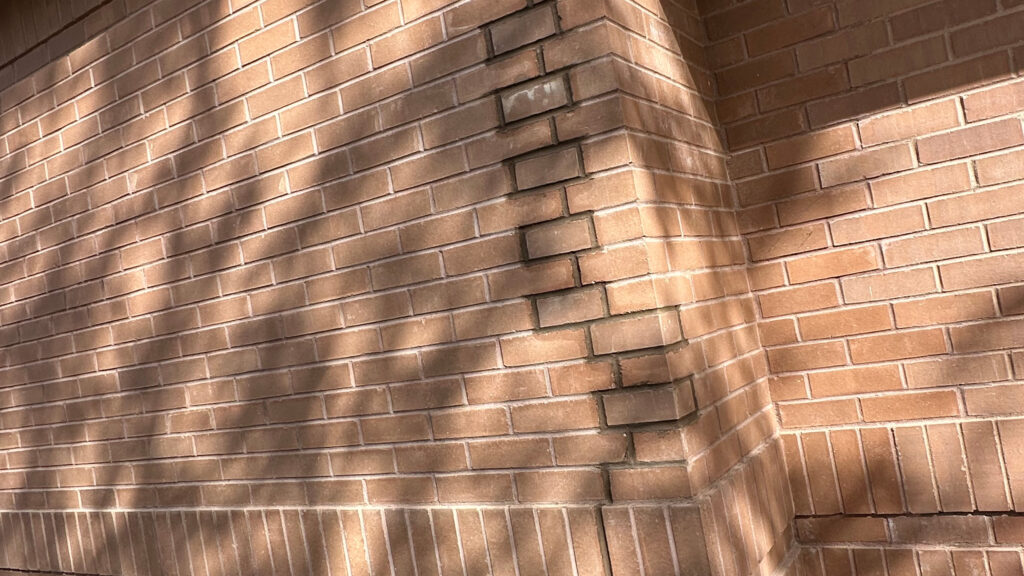
Phoenix Brick Repair: Spalling, Cracks, and Replacement
Brick damage in Phoenix is often a moisture problem wearing a masonry disguise. A popped face, a line of orange grit, or a few failed mortar joints can be cosmetic— or it can be evidence that water, salts, movement, or the wrong previous repair has been working on the wall for years.
It often starts with a small pile of orange grit at the base of a wall. Then a brick face flakes off in a thin sheet, exposing a softer, rougher core underneath. A few months later, there are three or four more.
That is spalling, and in the Phoenix area it is one of the most common reasons homeowners call for masonry repair. Some cases are mostly cosmetic. Others are telling you that water has been getting somewhere it should not for years.
How a Brick Is Built to Work
Fired clay brick is not uniform from face to core. The outer face is exposed to the highest kiln temperature and vitrifies, creating a harder, denser, less absorbent weather surface. The core behind it is softer and more porous.
Fired Face
The exterior surface is the brick’s main weather defense.
Porous Core
Once exposed, the softer interior takes on water and salts more readily.
Accelerated Erosion
After the face fails, the damaged brick often deteriorates much faster than it did before.
Why Patches Fail
Applied fillers and coatings sit on the soft core; they do not become a new fired surface.
When a spalled face comes off, the back of that face can be diagnostic. Chalky crystalline residue points toward moisture and salt moving from behind the face. A cleaner break can indicate a different mechanism such as stress or incompatible mortar.
Why Brick Spalls in the Phoenix Area
In colder climates, freeze-thaw cycling is the classic mechanism. In the Valley, the more common causes are different: trapped moisture, irrigation contact, rising damp, salt movement, and overly absorbent brick in exposed locations.
Film-forming coatings can block vapor from leaving through the face while water still enters through mortar, the top of the wall, or the base.
Repeated wetting from spray heads or hose bibs can create a stripe of failure across specific brick courses.
Moisture wicking from soil can deposit salts inside the pore structure, eventually forcing the fired face off.
Older or reclaimed brick can be more absorbent and may fail quickly at grade, near water sources, or below roof runoff.
Mortar that is too strong for older brick transfers movement and stress into the brick edges instead of the joint.
Cracks crossing multiple courses, bulging, or separation at corners point beyond surface deterioration and toward movement.
How to Read Brick Damage in Phoenix Homes and Walls
Not every mark on a brick wall means the same thing. The visible pattern usually tells you which direction to investigate first.
| What You See | Usual Cause | Severity | Typical Repair |
|---|---|---|---|
| Fine surface flaking, thin scales, grit at the base | Early salt or moisture cycling just under the face | Low, but progressive | Find and stop the moisture source, monitor, and clean gently |
| Face fully popped off, soft core exposed | Trapped moisture behind a coating or sustained wetting | Moderate and likely to spread | Cut out and replace affected units, remove failed coating, correct drainage |
| Stair-step cracking following mortar joints | Foundation or footing movement, soil-moisture change | Structural until proven otherwise | Evaluate the cause first, then repoint or rebuild the affected section |
| Vertical crack running straight through brick units | Significant movement or missing expansion accommodation | Structural | Structural evaluation, unit replacement, and joint correction |
| Crumbling brick in the lowest courses | Rising damp, salts, irrigation at grade | Moderate to high | Replace units and correct grade, irrigation, and drainage |
| Bulging, leaning, or out-of-plane wall | Wall-tie failure, backfill pressure, footing movement | High—treat as urgent | Do not patch; evaluate for rebuild of the affected section |
| Missing or broken individual brick | Impact, vehicle contact, or old unrepaired failure | Low if isolated | Cut out, replace, match, and repoint surrounding joints |
Cosmetic or Structural: The Honest Dividing Line
Usually a Durability Problem
- Surface loss confined to individual brick units.
- No wall displacement.
- No crack pattern crossing several courses.
- No visible widening over time.
Needs Structural Evaluation
- Stair-step cracks across several courses.
- Bulging, leaning, or out-of-plane masonry.
- Cracking that continues to widen.
- Separation at corners or adjoining materials.
The correct sequence is to determine why the wall moved before deciding what to do with the brick. Repairing masonry over an unresolved footing or soil-moisture problem creates a wall that may crack again in the same place.
Why Paint and Sealer Often Make the Problem Worse
Brick Needs a Way to Release Moisture
Film-forming coatings can close off the face while water still enters from mortar joints, grade, roof runoff, or the back side of the wall.
Vapor pressure then builds behind the coating until the coating and brick face separate together.
What Brick Replacement Actually Involves
Once a brick has lost its fired face, durable repair usually means replacing the unit rather than coating the exposed core.
Mortar should generally be softer than the brick around it so movement and salt damage are taken up by the joint, which can be renewed, rather than by the brick.
Brick Matching: Why It Is Harder Than It Sounds
Brick matching is a specialty because color alone is not enough. Size, firing color, texture, weathering, and mortar all have to be considered together.
Brick Variables
Dimensions, kiln color, face texture, manufacturing era, and weathering can all make a “close” brick look obviously wrong.
Mortar Variables
Joint color depends heavily on sand as well as pigment, and mortar occupies a large share of the visible wall.
| Variable | Why It Complicates the Match |
|---|---|
| Size and Format | Older brick dimensions may not match current production, which can change joint width and coursing. |
| Firing Color | Clay chemistry and kiln position influence color, so different production runs may vary. |
| Texture | Wire-cut, sand-faced, tumbled, and molded faces reflect light differently. |
| Weathering | Decades of sun and patina can make a new factory match look too fresh. |
| Mortar Color | A correct brick with mismatched mortar still reads as an obvious repair. |
New Era Masonry offers masonry color matching for repairs where blended units, salvage, or custom mortar matching are needed.
Cleaning and Restoration
Some walls do not need replacement yet. They need careful cleaning and the source of moisture corrected.
- Start with water and a soft brush.
- Use the mildest effective cleaner next.
- Test stronger products in an inconspicuous area first.
- Avoid driveway-level pressure on softer brick and mortar joints.
- Do not treat efflorescence as a permanent fix if the moisture source remains.
Common Repair Mistakes We See
When You Do Not Need a Repair Yet
Hairline Crack
If there is no displacement, no pattern across courses, and no change over time, monitoring can be reasonable.
Light Surface Flaking
If the moisture source has been found and stopped, the existing damage may stabilize.
Efflorescence Only
Correct the water source, clean gently, and watch for material loss before escalating the repair.
One Isolated Brick
A single damaged unit in an inconspicuous area may not justify immediate work if the rest of the wall is sound.
What Drives the Cost of Brick Repair
Brick repair quotes vary because conditions vary from wall to wall. The biggest cost drivers are the number of units, access, matching difficulty, coating removal, moisture correction, structural involvement, and surrounding mortar work.
What a Real Quote Should Include
- A written explanation of what likely caused the damage.
- The number of units expected to be replaced.
- The matching approach and expected visual result.
- The mortar approach and compatibility with the existing brick.
- Any drainage, grading, or irrigation work included or excluded.
- Arizona ROC license information and insurance confirmation.
- Permit responsibility where the scope requires it.
Frequently Asked Questions
What causes brick to spall?
Moisture and salt working inside the brick just behind its fired face. In Phoenix, common sources include trapped moisture behind coatings, sprinkler contact, and soil moisture wicking into lower courses.
Can you fix spalling brick without replacing it?
Not in a way that recreates the fired face. Once the face is gone, durable repair generally means replacing the affected units after the moisture source is addressed.
Is spalling brick dangerous?
Surface spalling on isolated units is not automatically a safety issue. Bulging, leaning, displacement, or cracking across multiple courses deserves prompt evaluation.
Can you stucco or render over spalled brick?
Covering the wall does not stop the mechanism causing the damage. Moisture issues and unsound units should be corrected before any new finish is applied.
How do you match brick on an older Phoenix home?
Through a combination of close modern equivalents, blended replacement units, salvage where practical, and separate mortar-color matching.
Should I seal my brick wall to prevent damage?
Not as a default. Film-forming sealers can trap moisture in walls that are already taking on water from behind or below.
How long does a brick repair take?
Small unit replacements can be short jobs. Matching, coating removal, scaffolding, summer curing conditions, and drainage or structural correction can extend the timeline.
Is brick repair the same as tuckpointing?
No. Brick repair addresses the masonry units themselves. Tuckpointing or repointing replaces deteriorated mortar in the joints.
Working With New Era Masonry
New Era Masonry is a licensed, bonded, and insured Arizona masonry contractor, ROC #339091, with more than forty years of trade experience carried across three generations.
The company handles masonry repairs, masonry color matching, tuck pointing, concrete pours, custom masonry, and demolition throughout the Phoenix metro area.
Have Brick Spalling, Cracks, or a Repair That Does Not Match?
Send photos of the affected wall and any history you know about painting, sealing, irrigation, drainage, or previous repair work—or schedule an on-site look so the cause can be identified before the repair is quoted.
Request a Site Evaluation View Masonry Repairs