
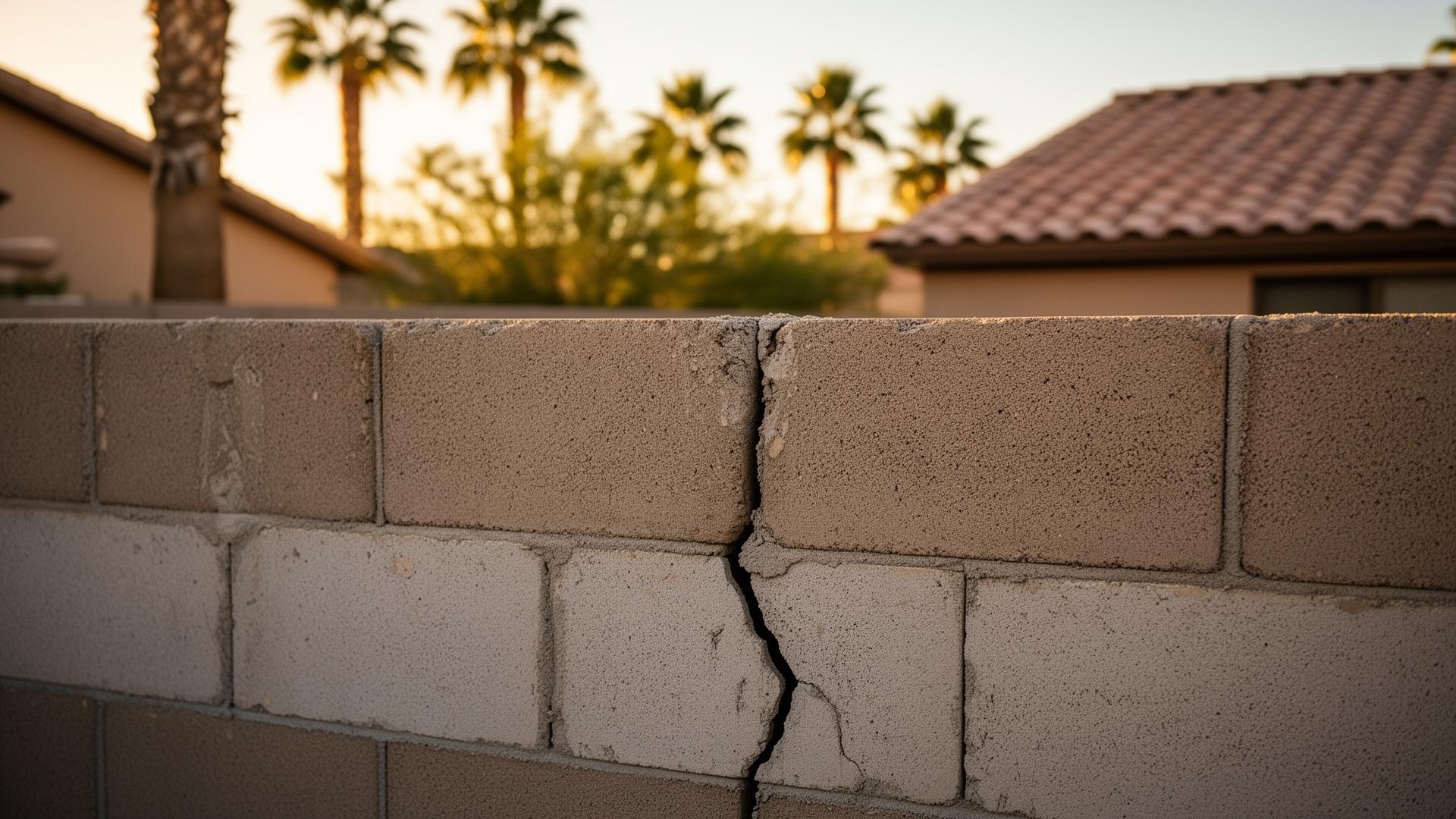
Block Wall Repair in Phoenix: Causes, Cost, and When to Repair vs. Replace
Drive any Phoenix neighborhood and you’ll see the same thing: mile after mile of painted cinder block walls separating yards, screening pools, and holding back desert hillsides.
Block walls are so common most homeowners forget they’re a structural element — until a crack appears, a section leans, or a monsoon storm shoves a panel out of plumb.
Block walls fail in Arizona for predictable reasons: expansive caliche soils, foundation settlement, irrigation overspray, root intrusion, and 40-year-old construction that predates today’s rebar and footing standards. The good news is most failures are repairable without tearing the whole wall down — if you catch them early and hire a mason who actually understands CMU construction.
This guide walks through what causes block walls to fail in the Valley, how to tell repair from replacement, real 2026 cost ranges, and what to look for when hiring a block wall contractor in Phoenix. For professional help, explore New Era Masonry’s masonry repair services.
Why Block Walls Crack and Lean in Phoenix
Phoenix is unusually hard on masonry. A few site-specific drivers do most of the damage:
- Expansive and collapsible soils. Much of the Valley sits on caliche, fat clay, or fill that swells when wet and shrinks when dry. That movement telegraphs straight up through a footing into the block above it as a stair-step crack along the mortar joints.
- Monsoon hydrostatic pressure. Short, violent summer storms saturate soil on one side of a wall — especially a retaining wall — and the pressure differential can push, tilt, or crack the assembly.
- Irrigation and pool overspray. Drip lines, sprinklers, and pool decks that drain toward a wall keep the base wet, soften footings, and accelerate efflorescence and mortar deterioration.
- Tree and shrub roots. Mesquite, palm, and ficus roots lift footings from below. By the time you see a bulge in the block, the root is usually six to ten feet under it.
- Original construction shortcuts. A lot of Phoenix block walls built in the 1970s–90s have minimal rebar, ungrouted cells, and shallow footings. They worked for thirty years. They don’t work forever.
- Vehicle impact and settlement at gate posts. Pilasters take the brunt of gate weight and the occasional fender. Cracks at pilasters are extremely common and almost always repairable.
Repair or Replace? A Simple Decision Framework
Not every cracked wall needs to come down. A licensed mason will look at three things before recommending repair vs. replacement:
1. Type and Pattern of Cracking
Hairline vertical cracks along a single mortar joint are usually cosmetic and can be tuck-pointed. Stair-step cracking through multiple courses signals foundation movement and needs a structural look.
2. Plumb and Displacement
A wall that’s out of plumb more than about 1 inch over 8 feet of height is typically past the point of cosmetic repair. Once a CMU wall starts leaning, gravity does the rest.
3. Footing Condition
If the footing has cracked, sunk, or been undermined by erosion or roots, repairing the block above it is throwing money at the wrong layer. The footing has to be addressed first.
As a rule of thumb: under about 25 linear feet of damage and the rest of the wall is plumb? Repair. Major displacement, multiple failure modes, or a wall that’s been patched twice already? Replacement is almost always cheaper over a 10-year horizon.
“Most of the block wall calls we get in Phoenix don’t need a teardown. They need someone who’ll actually open up the footing, look at the rebar, and fix the real problem instead of just slapping mortar over the symptom.”
— New Era Masonry, three-generation Phoenix masonry company
2026 Cost Ranges for Block Wall Repair in Phoenix
Pricing in the Valley moves with material costs, but the 2026 ranges below reflect what reputable, licensed Phoenix masonry contractors are quoting for typical residential work. Commercial and HOA-scale jobs price differently.
| Repair Type | Typical 2026 Cost Range | Common Notes |
|---|---|---|
| Tuck-pointing and mortar joint repair | $8–$18 per linear foot | Depends on access and how much old mortar must be ground out. |
| Hairline crack repair with masonry epoxy and color-matched paint | $200–$600 per wall section | Best for cosmetic or minor non-structural cracking. |
| Stair-step crack repair | $400–$1,200 per crack | May cost more if grouting and rebar additions are needed. |
| Pilaster rebuild | $900–$2,500 each | Depends on height and whether the footing needs work. |
| Partial wall rebuild | $1,200–$3,500 per 10-foot section | $2,500–$6,000+ if the footing has to be re-poured. |
| Full wall replacement | $35–$70 per linear foot installed | Typical standard 6-foot privacy wall with footing, rebar, grouted cells, and finish. |
| Retaining wall repair with engineered drainage | Starts around $85 per linear foot | Scales quickly with height and soil conditions. |
These ranges line up with what we publish in our 2026 Phoenix masonry pricing guide. Get more than one written, itemized bid — and walk away from anyone who refuses to put scope and materials in writing. You can also review New Era Masonry’s full list of masonry services before requesting an estimate.
Permits, Codes, and the Rules Most Homeowners Miss
The City of Phoenix and most Valley municipalities require a permit for any new freestanding wall over 3 feet tall and for any retaining wall over 3 feet of retained height, measured from the bottom of the footing. Repairs that replace more than a small section, change the height, or alter the structural design generally trigger a permit as well.
Block wall construction in Arizona is governed by the International Building Code Chapter 21 and TMS 402/602, The Masonry Society’s standard for masonry structures. Wind-load design follows ASCE 7. A licensed masonry contractor will know which rebar size and spacing your wall needs, what grout pour height your block manufacturer allows, and when an engineer’s stamp is required — usually for retaining walls over 4 feet or any wall surcharged by a slope or driveway above it.
HOAs add another layer. Painted color, cap style, and pilaster spacing are often dictated by CC&Rs, and a repair that doesn’t match the rest of the community can cost you a violation letter. A good contractor pulls the spec for you before quoting.
How to Hire a Block Wall Contractor in Phoenix Without Getting Burned
Block wall work attracts a lot of unlicensed handymen because the materials are cheap and the labor looks straightforward from the curb. It isn’t. Here’s the short checklist:
- Confirm an active Arizona ROC license in the right classification — typically CR-9 Masonry for residential block work. Verify it at roc.az.gov, not on the contractor’s business card.
- Ask for proof of general liability and workers’ comp insurance. A wall failure that hurts a neighbor is your problem if the contractor isn’t covered.
- Get the scope in writing: linear footage, block size and type, mortar mix, rebar size and spacing, grout pour, footing dimensions, finish, and cleanup.
- Look at finished work that’s at least two years old. Fresh masonry always looks good. Two-year-old masonry tells you whether the contractor controlled efflorescence, color match, and joint tooling.
- Ask who’s actually on the wall. A lot of Phoenix masonry is subbed to day labor. With a multi-generation crew, the person bidding the job is the person building it.
“A block wall is structural, not decorative. We’ve torn out walls in north Phoenix that were three years old because they were built without proper rebar or grout — and the homeowner paid full price for them the first time. Hire the license, not the lowest bid.”
— New Era Masonry
Preventing the Next Failure
Once a wall is repaired or rebuilt, a few small habits double its lifespan in the Valley:
- Move drip lines and sprinklers at least 18 inches off the footing. Constant moisture is the single biggest killer of Phoenix block walls.
- Re-seal painted walls every 5–7 years. UV breaks down the elastomeric coating that keeps water out of hairline cracks.
- Cut tree roots back from footings before they get thicker than a garden hose. Once a root is wrist-thick, the damage is already in the footing.
- Re-tool mortar joints at the first sign of erosion — it’s a $400 fix today, a $4,000 rebuild in five years.
- Walk the wall after every monsoon. Look for new cracks, fresh efflorescence, leaning, and any place the soil has washed out at the base.
Frequently Asked Questions
How long does block wall repair take?
Most cosmetic and tuck-pointing work is a half-day job. Stair-step crack repair runs one to two days. Partial rebuilds of 10–30 feet take three to five working days, plus cure time before paint. Full replacements with new footings are typically one to two weeks depending on length and access.
Will my homeowner’s insurance cover a damaged block wall?
Sometimes. Walls damaged by a sudden event — vehicle impact, a fallen tree, a covered monsoon wind event — are often covered. Walls that failed from soil settlement, root pressure, or original construction defects almost never are. A good contractor will document the failure mode in writing so you can submit it to your carrier.
Can I just patch a cracked block wall myself?
You can cosmetically. Masonry caulk and color-matched paint will hide a hairline crack for a season or two. But if the crack is structural — stair-step pattern, horizontal, or accompanied by leaning — patching it traps the real problem and makes the eventual repair more expensive.
Do I need a permit to repair my block wall in Phoenix?
Small cosmetic repairs and tuck-pointing typically don’t require a permit. Replacing more than a minor section, increasing wall height, rebuilding a retaining wall, or any structural change generally does. Your contractor should know — and pull — the permit on your behalf.
Why is my new wall already showing efflorescence?
That white powdery bloom is dissolved salts wicking out through the block as it dries. It’s normal for the first few months on new construction. If it persists past six months or keeps coming back after cleaning, there’s a moisture source — irrigation, drainage, or improperly sealed cap — that needs to be addressed.
How long should a block wall last in Phoenix?
A properly engineered, properly built block wall in the Valley should last 50–75 years with minimal maintenance. Walls that fail in under 20 years almost always trace back to footing, rebar, or grout shortcuts during original construction.
Get a Free Block Wall Repair Estimate in Phoenix
New Era Masonry has been building and repairing block walls across the Phoenix metro for three generations. Licensed, insured, and known for transparent written scopes — no vague bids, no surprise change orders, no subcontracted day labor on your wall.
We service Phoenix, Scottsdale, Paradise Valley, Gilbert, Chandler, Mesa, and the surrounding Valley. View our service areas or request a quote online.
Request a Free Estimate