
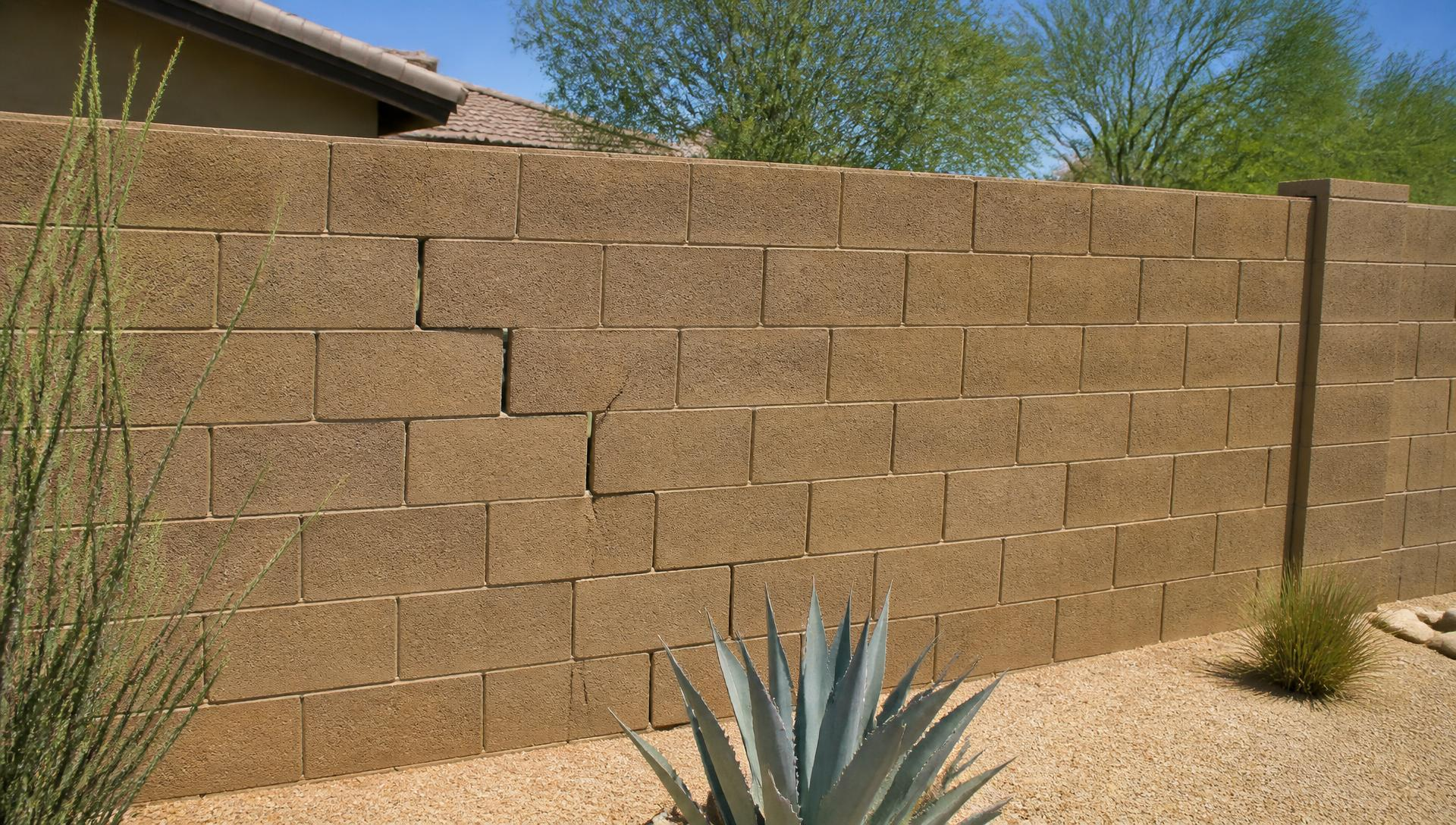
Block Wall Repair in Phoenix: Cracks, Leaning Walls, and When Repair Beats Replacement
Cracks, leaning sections, crumbling block, and loose mortar do not always mean a Phoenix block wall needs to be demolished. This 2026 guide explains what causes block wall failure in Arizona, how to read common warning signs, what homeowners can safely handle, and when professional masonry repair or replacement makes more sense.
In This Guide
- Why block walls crack in the Valley
- How to read different crack patterns
- Leaning versus bowing walls
- Crumbling block, spalling, and efflorescence
- What homeowners can safely repair
- Why common DIY patches fail
- Professional block wall repair methods
- When repair beats replacement
- Shared walls, neighbors, and HOAs
- How to prevent future wall failure
You probably noticed it after a storm. A thin line running diagonally through the mortar joints of your backyard block wall, or a section that suddenly looks like it is leaning a little further into the neighbor’s yard than it used to. Maybe the paint is flaking and the block underneath feels chalky and soft to the touch.
Block walls are everywhere in the Valley because they hold up well to heat, sun, and privacy needs better than wood fencing ever could. But they are not maintenance free, and the ground they sit on in Phoenix is unusually hard on them. The good news is that most block wall problems are repairable, and repair is almost always the smaller project. The trick is knowing which cracks are cosmetic and which ones are telling you the footing is moving.
This guide walks through what causes block wall failure in Arizona, how to read the cracks you are looking at, what homeowners can reasonably handle, what needs a mason, and how to decide between repairing and replacing.
Why Block Walls Crack in the Valley
A block wall is a stack of concrete units held together with mortar, usually with steel rebar and grout in some of the cores, sitting on a concrete footing below grade. It fails when something disturbs that footing or when water gets into the assembly. In the Phoenix area, that happens for a handful of very predictable reasons.
Expansive and Caliche Soils
Much of the Valley sits on soils that swell when wet and shrink when dry, plus hard caliche layers that make footings sit unevenly. Seasonal movement pushes and pulls on the wall from below.
Undersized or Missing Footings
Walls built quickly during past building booms sometimes sit on footings that are too shallow, too narrow, or poured without proper reinforcement. Those walls move first.
Irrigation Saturation
Drip lines, sprinkler heads, and planter beds placed right against the wall keep the soil at the base permanently damp. Wet soil loses bearing strength and carries salts into the block.
Monsoon Wind Load
A tall, solid wall is a sail. Sustained microburst winds put real lateral force on a wall that was never reinforced to take it, especially on long unbroken runs with no pilasters.
Heat Expansion Cycles
Surface temperatures on a sun-facing wall swing enormously between afternoon and pre-dawn. That daily expansion and contraction works mortar joints loose over years.
Missing Control Joints
Long walls need planned places to move. Without them, the wall picks its own place to crack, and it usually picks the weakest joint.
The most common combination: almost every damaged wall involves two or three contributing conditions. Water plus movement is the most common pairing by far.
Reading the Crack: What Your Wall Is Telling You
Not all cracks mean the same thing. The pattern, direction, and width matter more than the length. Use the table below as a first read, then confirm with a professional evaluation if anything falls in the structural column.
| Crack Type | Likely Cause | Severity and Typical Response |
|---|---|---|
| Hairline surface cracks in paint or stucco | Coating shrinkage, heat cycling, or normal curing. |
Cosmetic Clean, seal, and recoat. Monitor for widening. |
| Stair-step cracking along mortar joints | Differential footing settlement or soil movement under one section. |
Structural Indicator Needs evaluation. Often repairable with repointing plus footing correction. |
| Vertical crack through block and mortar | Thermal expansion without a control joint, or a point load on the footing. |
Moderate to Structural Usually repaired by creating a proper control joint or reinforcing the section. |
| Horizontal crack along a bed joint | Lateral pressure, water or soil pushing from one side, or corroding rebar. |
Urgent The most serious common pattern. Have it inspected before the next storm. |
| Displaced or offset block | Impact, severe settlement, or failed grout cores. |
Structural The affected block needs removal and replacement rather than surface patching. |
| Crumbling, flaking, or soft block faces | Water intrusion, salt migration, freeze damage at elevation, or internal rebar corrosion. |
Condition Dependent Isolated areas may be repairable. Widespread deterioration may justify replacement. |
A simple monitoring test: put a pencil mark at each end of a crack with the date, then check it again after the next monsoon cycle. A crack that stays put is a very different problem from one that grows a quarter inch in a season.
Leaning and Bowing Walls
Lean is the symptom homeowners most often ignore, and it is the one that rarely resolves on its own. A wall leans because the footing on one side has settled, because soil or water is pushing against one face, or because the wall was never reinforced enough to resist lateral load in the first place.
Uniform Lean
A wall that tips as a relatively rigid unit is usually pointing to movement or settlement at the footing. The masonry above the footing may still be relatively intact.
Bowing or Bulging
A wall that bulges outward through the middle of a run is failing within the wall itself. That usually means the internal reinforcement is not doing its job, making bowing the more dangerous condition.
Treat the wall as a hazard if it is visibly out of plumb, can be rocked by hand, or has an open horizontal crack. Keep children, pets, and vehicles away from the leaning face until the wall has been evaluated.
Crumbling Block, Spalling, and the White Powder
If your wall is shedding sandy grit or you can push a screwdriver into the face of a block, water has been moving through it. Two related things are usually happening at once.
Efflorescence
The white chalky bloom on a block face is a salt deposit. It is mostly cosmetic by itself, but it proves that water is passing through the wall and evaporating at the surface. Find the water source before simply cleaning the stain.
Rebar Corrosion
Steel inside a grouted core expands as it rusts. That expansion can crack the masonry from the inside out, which is why spalling sometimes follows a straight vertical line corresponding with a reinforced block core.
At higher elevations around the Valley and up toward the rim country, overnight freezing adds one more mechanism. Saturated block that freezes can flake at the face season after season.
What a Homeowner Can Reasonably Do
There is a real DIY zone here, and it is worth using. It is just narrower than most online guides suggest.
Reasonable DIY Work
- Clean and inspect. Remove vegetation and expose the full wall so you can see what is actually happening.
- Fix water sources. Move emitters and sprinkler heads away from the footing and regrade areas where water pools.
- Seal true hairline cracks. Use masonry crack filler and a breathable masonry sealer on cosmetic, nonmoving cracks.
- Repoint small mortar areas. Isolated loose joints can sometimes be raked out and repacked with compatible mortar.
- Document changes. Photograph cracks and record dates so future movement is easier to recognize.
Call a Mason
- Anything involving the footing or foundation.
- A wall that is leaning, bowing, or moving.
- Horizontal or significant stair-step cracks.
- Repairs requiring block removal.
- Internal reinforcement or grouting work.
- Conditions requiring safe wall shoring before repair.
Why DIY Patching So Often Fails
Homeowners are rarely wrong about wanting to fix it themselves. They are usually wrong about what the crack is.
- Caulking over structural movement: flexible sealant hides the crack temporarily but does nothing to stop the footing or wall from moving.
- Using mortar that is too hard: overly strong modern mortar can force the older block to crack instead of allowing movement through the joint.
- Patching without correcting drainage: if the same moisture conditions remain, the repair tends to fail on the same schedule as the original material.
If you have not identified and fixed the cause of the crack, you are decorating it, not repairing it.
New Era MasonryProfessional Block Wall Repair Methods
Tuckpointing and Repointing
Failed mortar joints are raked out to a consistent depth and repacked with mortar matched to the original in strength and color. This is a workhorse repair for walls that are structurally sound but weathered.
Block Replacement
Cracked, spalled, or displaced units are cut out and replaced individually while surrounding courses are supported. Matching texture and color on an older wall can require careful sourcing.
Core Reinforcement With Rebar and Grout
Where vertical steel is missing or insufficient, selected cores may be opened, tied into the footing where possible, reinforced with rebar, and filled with structural grout.
Footing Repair and Underpinning
If settlement caused the damage, the real repair happens below grade. Depending on the wall, this may involve widening the footing, extending it, installing supports, or rebuilding part of the foundation.
Pilasters and Buttressing
Reinforced pilasters installed along a long wall run provide additional lateral support and reduce the “sail effect” that makes tall unbroken walls vulnerable to strong monsoon winds.
Resurfacing and Protective Coatings
Once structural repairs are complete, stucco, block filler, or an appropriate masonry coating can restore appearance and improve resistance to moisture. Coating should be the last step, not the diagnostic step.
For help choosing the right repair method for an existing wall, explore New Era Masonry’s masonry services or request an on-site evaluation.
Repair or Replace: A Practical Decision Framework
Replacement is not automatically the safer choice. A well-executed repair on a fundamentally sound wall can last for decades. The question is whether the bones of the wall are still good.
| Wall Condition | Typical Approach | When Replacement Wins |
|---|---|---|
| Isolated cracking, wall plumb, footing intact | Repoint, seal, and correct drainage. | Rarely. Repair is usually the right call. |
| Stair-step cracking in one section | Correct the footing issue and locally rebuild the affected section. | When the same settlement pattern repeats throughout several portions of the wall. |
| Visible lean under a few degrees, no bowing | Underpin the footing, reinforce cores, and potentially add pilasters. | When movement continues year after year despite previous repair attempts. |
| Bowing or bulging in the middle | Remove and rebuild the affected section with proper reinforcement. | Often. Bowing usually indicates failure of the structural reinforcement itself. |
| Widespread crumbling and spalling | Determine whether any portion of the run remains salvageable. | Usually, when long-term saturation has deteriorated much of the wall. |
| Wall built without a real footing | Evaluate whether a proper new footing can be incorporated. | Frequently. A wall without a dependable foundation is difficult to correct with surface repairs. |
One more factor pushes the decision toward replacement: if you already plan to raise the wall, add a gate, substantially alter the run, or change the property-line layout, rebuilding a marginal section during the same project can be more efficient than repairing it twice.
Shared Walls, Neighbors, and HOAs
In Arizona, many backyard block walls sit directly on or very near a property line, which means responsibility may be shared. Before repair work begins, clarify the wall’s location, community requirements, and how costs or access will be handled.
Confirm Where the Wall Sits
A survey or plat map can help establish whether the masonry sits directly on the property line, entirely on one parcel, or functions as a common wall.
Check HOA Requirements
Valley HOAs may regulate wall height, color, block type, location, and finish. Some communities also maintain specific perimeter or view-fence walls themselves.
Discuss Responsibility Early
Neighbors often share the cost of work on a genuinely shared wall, but that conversation should happen before scheduling the crew rather than after work begins.
A professional masonry contractor can also help provide repair details and documentation when an HOA architectural review committee requires them.
Preventing the Next Block Wall Failure
Once a wall is repaired, keeping it sound is mostly about controlling water and catching movement early.
- Keep irrigation at least a couple of feet away from the base where practical, and prevent sprinkler heads from spraying the masonry directly.
- Maintain positive grading so stormwater moves away from the footing instead of collecting alongside it.
- Use a breathable masonry sealer on an appropriate maintenance cycle so moisture that enters the wall can still escape.
- Trim vegetation and remove vines that keep the masonry damp or work roots into mortar joints.
- Walk the full wall twice per year—ideally before monsoon season and again afterward—and photograph anything new.
- Address small cracks during the season they appear. Repairs tend to be simpler while movement and deterioration are still limited.
Frequently Asked Questions
How do I repair cracks in a concrete block wall?
For genuine hairline surface cracks, clean the crack, apply a masonry crack filler, and seal the surface. For anything wider than a credit card edge, running in a stair-step pattern, or paired with a lean, the crack is a symptom rather than the problem, and it needs a mason to identify what is moving before it is filled.
What causes a crumbling cinder block wall, and can it be fixed?
Crumbling almost always means sustained water exposure, often combined with salt migration or rusting rebar inside the cores. Isolated crumbling block can be cut out and replaced. Widespread crumbling across a whole run usually means the wall has been wet for years and rebuilding is the more durable answer.
Is a leaning block wall dangerous?
It can be. A wall that is visibly out of plumb, that moves when pushed, or that has an open horizontal crack should be treated as a hazard and evaluated promptly. Monsoon winds put substantial lateral load on tall walls, and a compromised wall is most likely to fail during a storm.
Should I use caulk or mortar to fix a mortar joint?
Mortar, in almost every case. Caulk belongs in a designed control joint, not in a structural bed joint. Filling a failed mortar joint with sealant traps moisture and does nothing for strength.
Can a leaning wall be straightened, or does it have to come down?
It depends on the cause. Walls leaning because of footing settlement can often be underpinned, reinforced, and stabilized in place. Walls that are bowing in the middle of a run, or leaning severely, are usually rebuilt because the internal reinforcement has already failed.
How long should a block wall last in Arizona?
A properly built block wall with an adequate footing, correct reinforcement, and controlled drainage should serve for decades with only periodic sealing and repointing. Walls that fail early almost always trace back to footing, water, or reinforcement shortcuts at the time of construction.
Get Your Wall Evaluated Before the Next Storm
The difference between a repointing job and a rebuild is often a couple of seasons of ignoring a crack. If your block wall is cracking, crumbling, leaning, or bowing, the most useful next step is evaluating the footing and crack pattern together instead of simply covering the visible damage.
New Era Masonry provides block wall repair, reinforcement, footing correction, and rebuild services throughout the Phoenix metro area, including Scottsdale, Mesa, Tempe, Chandler, Gilbert, Glendale, Peoria, and Surprise.
Reach out to schedule an evaluation and determine whether your wall can be repaired or whether rebuilding is the more durable option.
Request a Block Wall Evaluation View Masonry Services View Completed Projects