
Concrete Driveway Installation in Phoenix: Costs, Thickness, and Planning
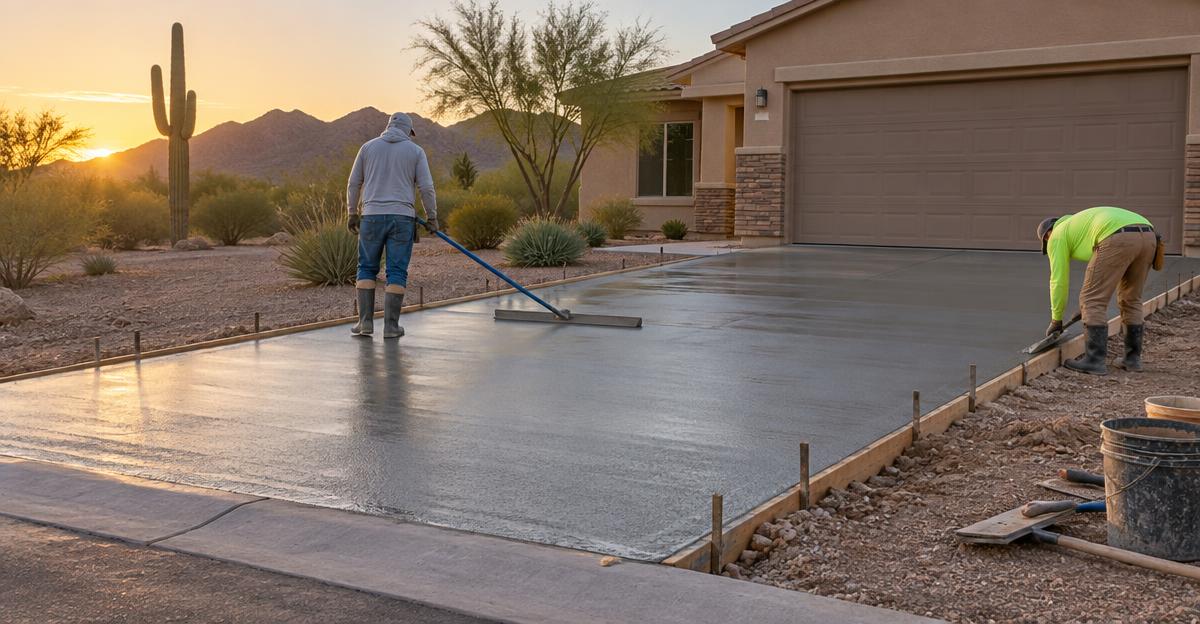
A driveway in Phoenix faces relentless sun, heavy monsoon runoff, and the daily weight of vehicles. A proper concrete driveway installation Phoenix AZ requires the right subgrade, accurate slab thickness, steel reinforcement, and a strict curing process to survive the desert climate without breaking apart.
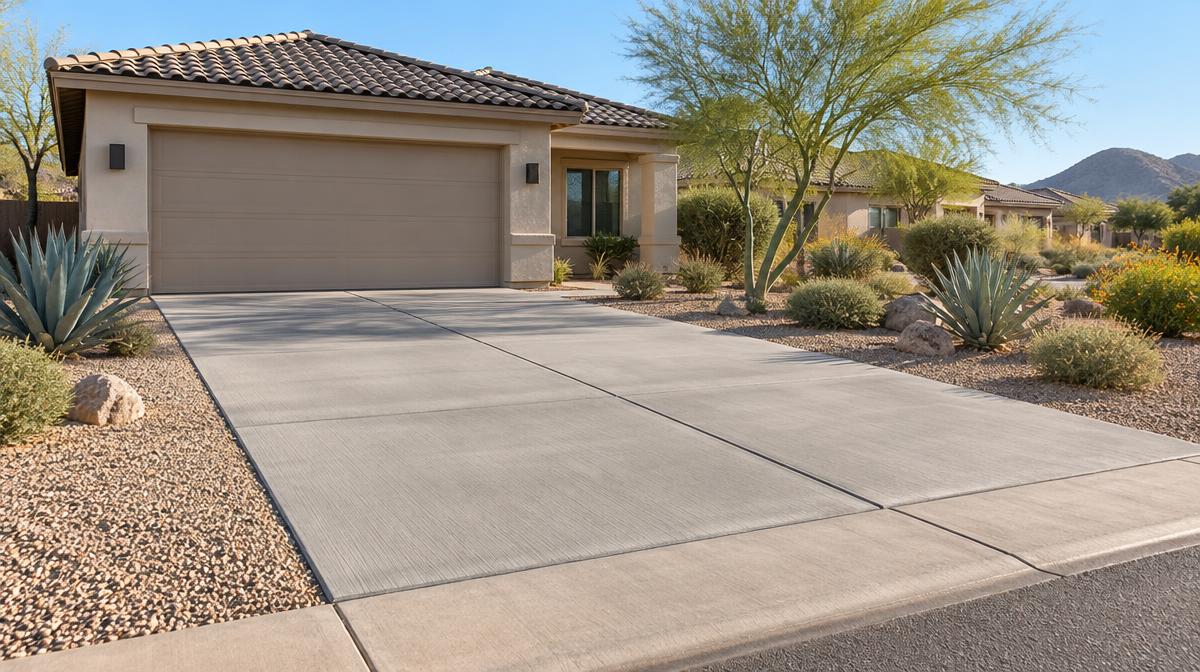
Replacing or installing a concrete driveway is a major investment. The difference between a slab that lasts 30 years and one that fails in three comes down to preparation and materials.
This guide breaks down concrete driveway cost Phoenix AZ, standard thickness requirements, reinforcement options, and what to expect during the pour.
Key Takeaways
- Standard driveway thickness is 4 inches for passenger cars, but 5 to 6 inches is required for heavy trucks or RV parking.
- Concrete driveway cost Phoenix AZ typically ranges from $8 to $12 per square foot, depending on demolition, site prep, and finish.
- Phoenix heat requires careful curing. Concrete that dries too fast loses up to half its potential strength.
- Control joints must be cut at specific intervals to guide inevitable shrinkage cracks.
- Rebar or welded wire mesh holds the slab together if the ground settles, but it does not prevent all cracking.
What Drives Concrete Driveway Cost Phoenix AZ
Pricing a concrete driveway Phoenix project involves more than just the cost of the wet mix. Several variables dictate the final price per square foot.
Removing and hauling away an old driveway adds $2 to $4 per square foot in labor and dump fees.
Excavating native soil and importing aggregate base course costs money but prevents settlement.
A standard 3,000 PSI mix costs less than a high-strength 4,000 PSI mix used for heavier loads.
Adding steel rebar costs more than wire mesh but provides superior structural support.
Access to the site plays a major role. If a concrete truck cannot back directly up to the pour area, the contractor must use a concrete pump, which adds hundreds of dollars to the daily equipment cost.
Standard Costs for a Concrete Driveway Phoenix
While every property is different, homeowners can expect specific price ranges based on the scope of work. These figures represent realistic ranges for licensed contractors in the Phoenix metro area.
| Project Type | Estimated Cost Per Sq. Ft. | What It Includes |
|---|---|---|
| Basic New Installation | $8 to $10 | Grading, 4-inch slab, wire mesh, broom finish |
| Heavy-Duty Installation | $10 to $12 | Grading, 5-inch or 6-inch slab, steel rebar, broom finish |
| Remove and Replace | $10 to $14 | Demolition, hauling, base prep, 4-inch slab, reinforcement |
| Stamped or Colored | $12 to $18+ | Base prep, 4-inch slab, integral color, stamping, sealing |
Accepting a bid that is drastically lower than the market rate usually means the contractor is cutting corners on base preparation, slab thickness, or reinforcement. These shortcuts lead to failure within the first few years.
Choosing the Right Slab Thickness
Concrete thickness determines load capacity. Adding just one inch of concrete increases the load-bearing capacity of the slab by nearly 50 percent.
4-Inch Slab
This is the standard for residential driveways. It easily supports passenger cars, SUVs, and light pickup trucks.
6-Inch Slab
Required for RV pads, heavy equipment, or delivery trucks. It is also recommended if the native soil is highly expansive or unstable.
Subgrade and Base Preparation
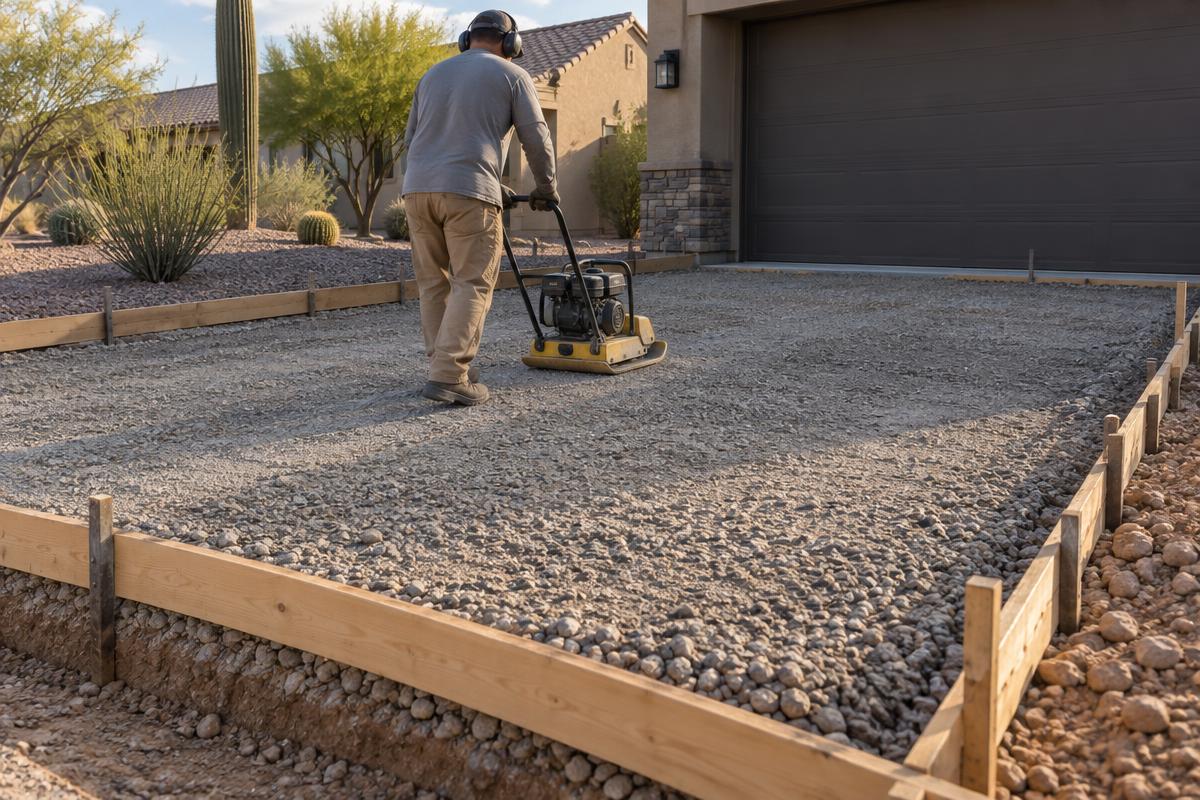
Concrete is only as stable as the ground beneath it. Pouring concrete directly over loose dirt guarantees settlement cracks.
The crew removes organic topsoil, roots, and loose dirt to reach a stable soil layer.
A layer of crushed rock and gravel is imported to create a stable, draining foundation.
The base material is compacted using heavy plate compactors or rollers to prevent future settling.
The base is dampened before the pour so dry dirt does not suck water out of the fresh concrete.
Reinforcement Options: Rebar vs. Wire Mesh
Concrete has high compressive strength but low tensile strength. It handles weight well but pulls apart easily. Reinforcement holds the slab together when the ground shifts.
Steel Rebar
Placed in a grid pattern, rebar provides heavy structural support. It keeps the slab locked together even if the soil settles underneath, making it ideal for heavy vehicle traffic.
Welded Wire Mesh
A grid of thick wire that helps control temperature-related cracking. It is cheaper than rebar but offers less structural support for heavy loads.
The Pour Process in Phoenix Heat
Phoenix weather creates unique challenges for concrete work. High temperatures cause concrete to set rapidly, which can lead to weak surfaces and severe cracking if not managed correctly.
- Schedule early morning pours to avoid the peak heat of the afternoon.
- Dampen the subgrade immediately before placing the concrete.
- Place and screed the concrete quickly to establish the correct grade and drainage slope.
- Apply a broom finish to create a slip-resistant surface for vehicles and pedestrians.
- Apply a liquid curing compound immediately after finishing to trap moisture inside the slab.
Concrete does not dry. It cures through a chemical reaction called hydration. If the water evaporates before hydration is complete, the concrete will be weak and prone to surface flaking.
Control Joints and Crack Management
All concrete cracks as it shrinks during the curing process. Control joints are planned cuts that force the concrete to crack in a straight, hidden line rather than randomly across the surface.
| Joint Rule | Specification | Why It Matters |
|---|---|---|
| Depth | 1/4 of slab thickness | A 4-inch slab needs a 1-inch deep cut to create a proper weak point. |
| Spacing | 2 to 3 times thickness in feet | A 4-inch slab should have joints spaced 8 to 12 feet apart. |
| Timing | Within 12 to 24 hours | Cutting too late allows random shrinkage cracks to form first. |
How Concrete Driveways Fail
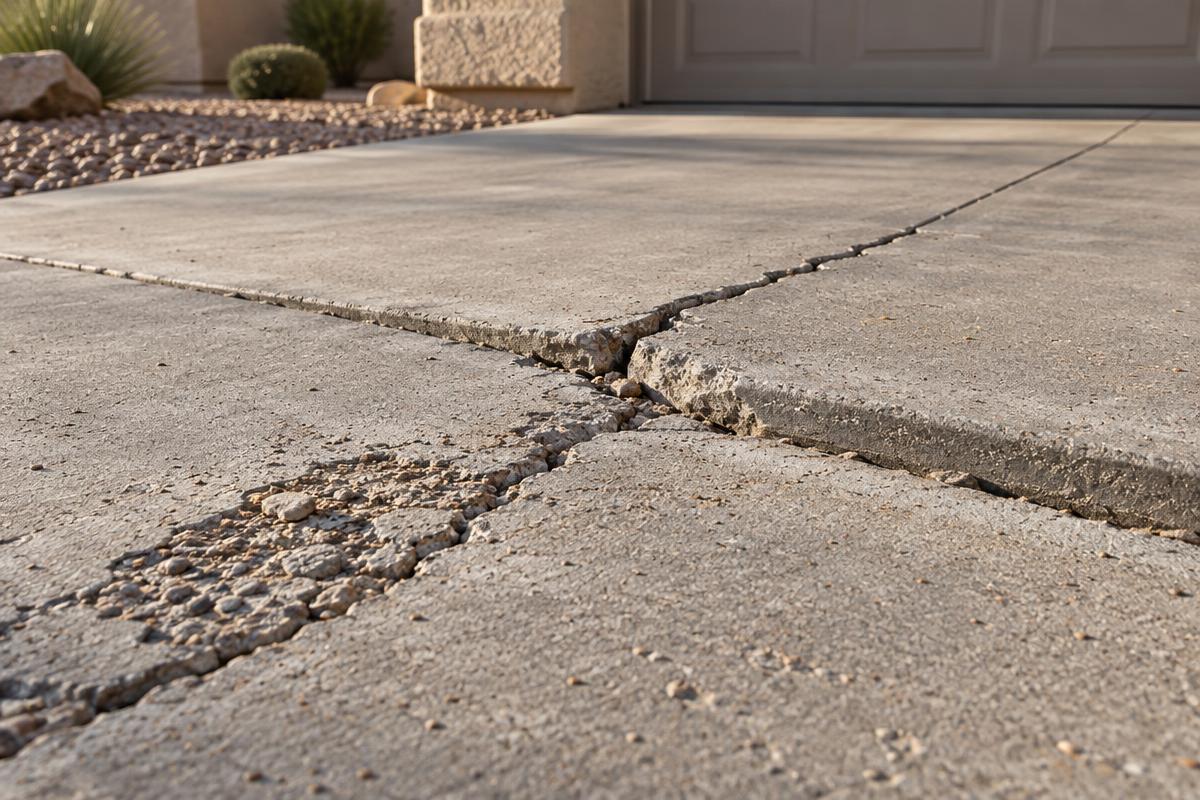
Recognizing the signs of failure helps homeowners understand why proper installation matters.
Surface Spalling
The top layer flakes off. This happens when the surface dries too fast during curing, or when excess water is troweled into the top during finishing.
Settlement Cracks
Wide, uneven cracks indicate the soil beneath the slab was poorly compacted or washed away by poor drainage.
Shrinkage Cracks
Random, jagged cracks across the slab usually mean control joints were spaced too far apart or cut too shallow.
Tree Root Heaving
Large roots from nearby trees grow under the slab and physically lift the concrete, causing severe cracking and trip hazards.
What to Ask Your Concrete Contractor
Before signing a contract for a concrete driveway Phoenix project, verify the technical details of the bid.
Frequently Asked Questions
Do I need a permit for a concrete driveway in Phoenix?
Yes, if the work involves the driveway approach connecting to the city street or sidewalk. Work entirely on private property may not require a permit, but right-of-way work always does.
How long until I can drive on my new driveway?
You can walk on new concrete after 24 hours. Wait at least 7 days before driving standard passenger vehicles on it, and 28 days before parking heavy trucks or RVs.
Can you pour concrete in the Phoenix summer?
Yes, but it requires strict hot-weather procedures. Contractors pour at dawn, use chilled water in the mix, and apply curing compounds immediately to prevent rapid evaporation.
Why did my new concrete driveway crack?
Hairline cracks inside control joints are intentional and normal. Random cracks outside the joints are usually caused by rapid drying, lack of control joints, or subgrade settlement.
Talk to a Phoenix Concrete Contractor About Your Driveway
New Era Masonry works throughout Phoenix, Gilbert, Mesa, Scottsdale, Paradise Valley, and surrounding communities. We handle concrete driveway installation, RV pads, patios, block walls, and custom masonry projects.
If you need an old, cracked driveway replaced or a new slab poured correctly from the start, reach out for a written proposal. Licensed, bonded, and insured, ROC #339091.
Ready to Plan Your Concrete Driveway?
New Era Masonry can evaluate your property, explain the necessary base preparation, and provide a clear, detailed bid for your concrete project.
Request a Written Proposal View Our ServicesWritten by the New Era Masonry team, an Arizona contractor with more than 40 years of block, brick, stone, and concrete work across three generations.